

Crossing between close relatives can cause losses of up to 25% of fingerlings and 30% in survivor production.
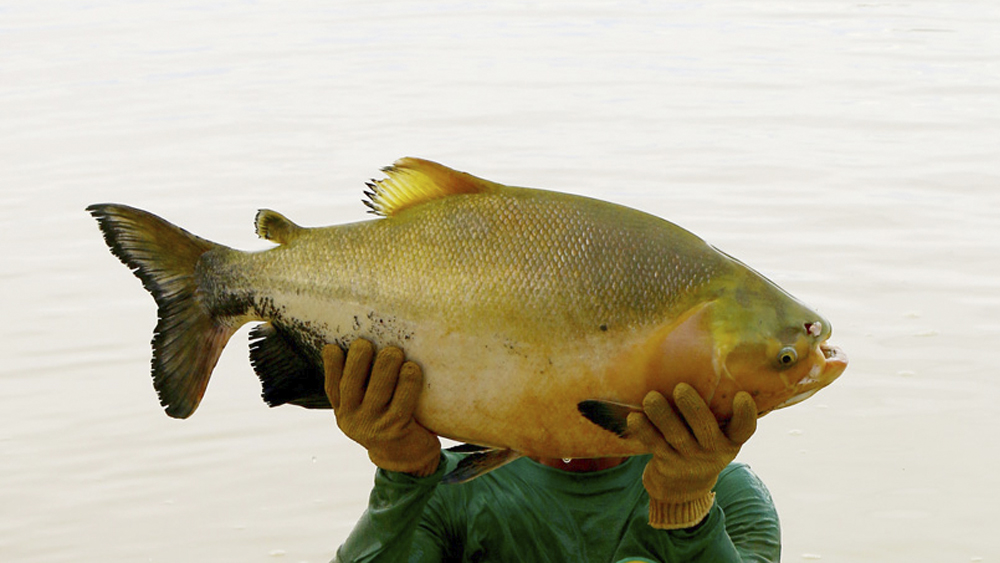
From September 4, Brazilian breeders of tambaqui (Colossoma macropomum) will have a technical service to know if their matrices are pure or hybrid (crossbreeding with another species) and if they are related to each other. This information is important for the good technical performance of the creation and will be generated through genomic tools developed by Embrapa.
To access the service, initially restricted, the fish farmer must contact Embrapa by e-mail alexandre.caetano@embrapa.br and start the process of hiring the service by means of a letter of proposal. The breeders and matrices to be analyzed must be individually identified with an electronic chip and part of the fin collected according to pre-established technical procedures (see booklet). After the contract is signed, the material will be sent to Embrapa, which will perform the analysis and return to the producer a spreadsheet with information on the degree of kinship between animals and purity of each, as well as guidelines for the use of the information.
“Each fish farmer can send up to 48 samples of preferably breeding fish. The results will be useful for guiding mating and thus avoiding losses in fry and the birth of animals with deformation and poor productive performance in fattening ”, explains the researcher of Embrapa Genetic Resources and Biotechnology Alexandre Caetano. The sample analysis service for purity and kinship will be offered on a restricted scale and with reduced values, at a cost of R $ 120.00 per sample. The hiring will be by type of service: one to detect the specific purity (R $ 60,00); and another contract for the service to identify the parent's pedigree relationships (R $ 60.00).
The importance of genealogical control
The scientist says that pedigree control is one of the main challenges faced today by tambaqui breeders in Brazil. Crossing between close relatives (half siblings, siblings or cousins) can cause losses of up to 25% of fingerlings, and up to 30% in the production of survivors in the fattening phase. He reveals that this was the challenge that led Embrapa to develop cutting-edge genomic tools for analysis and certification of kinship and species purity.
Because they do not associate inbreeding (related animals) with problems of weight loss during the fattening phase, producers often resort to nutritional and food supplements. Thus, in addition to increasing production costs, they run the risk of additional losses by introducing new variables into the production cycle.
“Often the farmer is not even aware of the damage he suffers from the lack of productive performance of fingerlings generated by breeding related kin. This innovative technology will help the fish farmer choose the matrices accurately and quickly, at an affordable cost ”, explains the researcher of Embrapa Informática Agropecuária (SP) Michel Yamagishi. “With this, the fish farmers will be able to maintain and even expand their production, with a significant reduction in expenses,” he says.
Source: Embrapa
Image: Embrapa